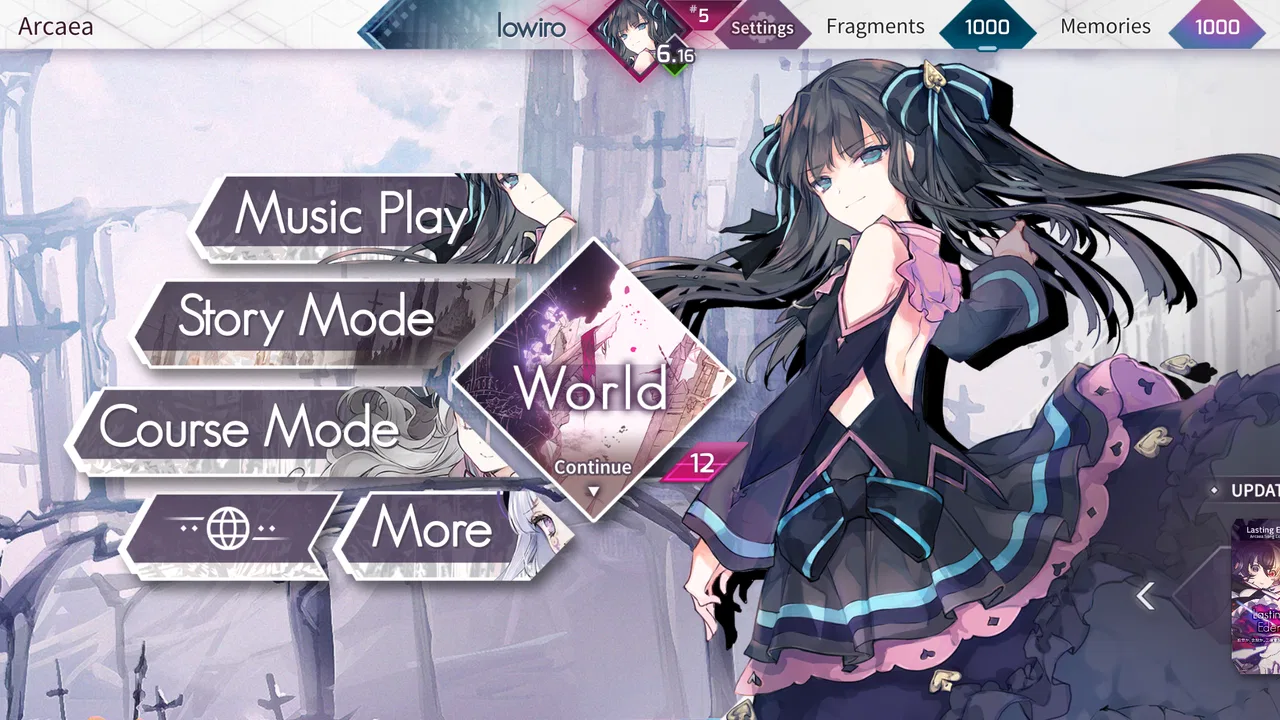
Arcaea
- 4.7
- Rating
- 5.00M
- Installs
- Free
- Price

 Analysis by App-foxy
I expected a stylish music game when I opened Arcaea, but the first few minutes made it clear that it asks for more attention than a typical tap-to-the-beat app. Notes arrive across a three-dimensional-looking play area, and success depends on reading their position, timing, and movement together. The result feels closer to learning a musical instrument than casually pressing buttons during a song.
That learning curve is the main reason I would recommend it selectively. If you enjoy rhythm games and like improving through repetition, this is one of the most satisfying choices I have played on a phone. If you want something relaxing that you can understand immediately, the opening may feel demanding. Arcaea is free to start, aimed at Teen players, and developed by lowiro. Its strong reputation is reflected in a 4.7 average from around 144 thousand ratings, while more than 5 million people have installed it.
What to expect before your first song
The game presents itself as a new-dimension rhythm experience, and that description makes sense once the notes begin moving through different visual layers. You are not simply watching a horizontal line and tapping when objects reach it. Some actions require taps, some require holding, and others ask you to follow motion across the play space. The visual presentation is attractive, but it also means that your eyes must learn a new way to read rhythm.
You May Also Like

 Blood Strike: 2.5 Anniversary
Blood Strike’s Loadouts Turn Every Drop Into a Tactical Gamble
A close look at Blood Strike’s custom loadouts: how fast access to signature weapons reshapes its battle royale rhythm, rewards preparation, and narrows the gap between fights.

 Pandora - Music & Podcasts
Pandora’s Music Is Easy to Start, but Harder to Recover
Pandora’s strength is its low-effort path from a seed to a station. Its weak spot is how much confidence it asks you to place in connection, setup, and quiet recovery.

 8 Ball Pool
 Is Built on Rivalries, Rematches, and Routine
A close look at the rivalries, rematches, shared routines, and unanswered safety questions that turn a quick pool match into a persistent mobile community.

 Samsung Music
’s Quiet Strength Is Playing What You Already Own
Its reach comes less from spectacle than from dependable access to a personal library. That simplicity is both the app’s strongest retention engine and its ceiling.

 AccuWeather: Weather Radar
AccuWeather Review: A Quick, Clear Forecast for Everyday Decisions
For everyday plans, the best forecast is the one you can understand quickly. AccuWeather makes rain timing, radar, and local conditions easy to act on, with a few trade-offs.

 Hill Climb Racing
Why Hill Climb Racing Still Turns Crashes Into One More Run
A tiny car, a bumpy hill and one more upgrade: Hill Climb Racing keeps resurfacing because its simple chaos makes every near-miss feel personal.
More From Our News Desk



I found the music-game category label useful but incomplete. Arcaea is not built like a simple playlist with a few difficulty buttons attached. Its songs are exercises in timing, visual tracking, and hand coordination. Even when a track sounds familiar in structure, the chart can make it feel completely different because the notes may ask for alternating fingers, sustained contact, or quick movement between areas of the screen.
The best mindset is to treat the early sessions as practice rather than a test of musical ability. I initially made mistakes because I watched the effects instead of the incoming notes. Once I focused farther ahead and allowed the notes to come toward me, the patterns became easier to anticipate. That small change is one of the first meaningful breakthroughs a new player can have.
Arcaea is also more comfortable for someone who enjoys repeating a song without feeling that repetition is wasted time. A failed attempt teaches you where your reading breaks down, while a successful run can reveal that a difficult section was only difficult because your hands were tense. Players who prefer constant novelty may find this loop less appealing than a broader casual music app.
The game is free, which makes trying it straightforward, although in-app purchases range from $0.99 to $9.99 per item. I would not decide on purchases during the first session. The important question is whether the core timing and chart style suit you. Spend time with the opening material, learn how the controls feel on your device, and only then consider whether you want more content.
Installing it and making the first session comfortable
The current version is 6.12.10 and it supports Android devices running version 5.0 or later. On iOS, the practical advice is the same as with any touch rhythm game: use a device that feels responsive, keep the screen clean, and play somewhere you can hold it steadily. A small amount of finger drag or an awkward grip can make a chart feel harder than it really is.
I recommend beginning with the device in the position that feels most natural rather than copying another player’s setup. Some people prefer holding the phone firmly with both hands; others rest it on a table so their fingers can move more freely. The right choice depends on screen size and hand position. What matters is consistency, because changing your grip between attempts makes it harder to tell whether you are improving.
Before chasing high scores, check that your taps line up with what you hear and see. Rhythm games can feel unfair when the timing is simply unfamiliar. Use the opening songs to learn the relationship between the falling objects and the beat. If a chart seems consistently early or late, adjust your timing approach instead of repeatedly blaming your fingers.
Headphones can help when your surroundings are noisy, especially because the music provides useful timing information. They are not a substitute for visual reading, though. Some sections are easier to understand by watching the path of the notes, while others become clearer when the beat is prominent. I switch between visual and audio attention depending on the chart rather than relying entirely on one sense.
A useful first-session routine is short and deliberate. Play one song to understand its layout, replay it while looking farther ahead, then take a brief pause before trying again. Long unfocused sessions usually create frustration. When my hands started making random corrections, stopping for a few minutes helped more than forcing another attempt.
Finding the first meaningful success
Your first goal should not be a perfect performance. I would aim to finish a song while maintaining control over the basic note types. That gives you a clearer sense of the game than immediately selecting the most visually impressive chart. A completion with a few mistakes is more useful than an early attempt that ends with you unsure why the screen became overwhelming.
Start by identifying the repeated pattern in a section. If several notes arrive in a steady sequence, let your fingers settle into that rhythm instead of treating every note as a separate emergency. For held notes, keep your contact stable and avoid lifting early just because another object appears nearby. For moving notes, follow their path smoothly rather than making several sharp corrections.
One of the less obvious lessons is that accuracy often improves when you use less force. I used to tap hard when a section looked difficult, which made my hands slower and increased tension. A lighter touch gave me more time to move to the next object. This is especially helpful during longer sessions, where physical strain can become the real obstacle.
Another practical tip is to watch the space just before the judgment area instead of staring directly at it. Looking too close gives your brain almost no time to plan. Looking slightly ahead lets you recognize whether the next action is a tap, a hold, or a movement. This habit takes a few attempts to feel natural, but it is one of the fastest ways to turn visual chaos into a readable sequence.
When you finally clear a song that previously defeated you, notice what changed. Sometimes the improvement comes from memorizing a pattern, but often it comes from fixing one small habit: releasing holds too soon, crossing fingers awkwardly, or reacting to effects instead of notes. That makes the progress feel earned and gives you a method for handling future charts.
Why the visual design can confuse new players
The presentation is one of Arcaea’s strengths, yet it can also hide the information you need. Bright effects and moving lanes are exciting, but a new player may instinctively follow the decoration rather than the playable objects. I had better results after mentally separating the screen into two layers: the music and notes were instructions, while the surrounding effects were atmosphere.
Arcs and other moving elements can be particularly confusing because they require continuous attention rather than a single reaction. I found it helpful to begin the movement with the correct hand position and then guide the finger along the path at a calm speed. Chasing the object with sudden jumps often caused me to lose contact or arrive late.
Do not assume that every mistake means you selected a difficulty beyond your ability. Sometimes a chart is manageable except for one pattern that has not yet become familiar. Instead of abandoning it immediately, replay the song and focus only on that troublesome passage. Learning to isolate a problem is more efficient than restarting without knowing what you are trying to fix.
There is also a difference between understanding a chart and having the stamina to perform it. A song may look clear during the first half and become difficult because your hands are tired. If your accuracy declines gradually, take that as a physical warning rather than a failure of concentration. Short sessions are not merely more comfortable; they can produce better practice.
Players coming from simpler rhythm games may need time to stop expecting every note to behave in the same way. Arcaea rewards reading the shape and direction of a sequence. That is why it can feel awkward at first even if you already play other music games. Familiar rhythm-game instincts help, but they do not completely replace learning this game’s visual language.
Building a routine instead of chasing difficulty
Once the first clear feels reliable, I suggest choosing one song that is comfortable and one that exposes a weakness. The comfortable track helps you maintain timing, while the challenging one gives your practice a purpose. Switching between them prevents the session from becoming either repetitive or discouraging.
For difficult patterns, use a progression based on control. First try to recognize where the section begins. Next, decide which hand will handle each movement. Then attempt the passage without worrying about the final result. Only after the motion feels familiar should you focus on accuracy. This approach is slower than blindly repeating the full song, but it produces more dependable improvement.
Playing on a phone during a commute may sound convenient, but I would be careful about using Arcaea in a crowded or shaky environment. The game benefits from stable hand positioning and concentration. A quiet room, a desk, or a short break at home is a better setting for learning. Casual play is possible, but serious progress is easier when the screen and your hands are not constantly moving.
The game can also work as a focused reset between other tasks. I sometimes prefer one or two songs during a break rather than opening a social feed, because the chart gives my attention a clear target. The trade-off is that a difficult attempt can leave me more tense if I start while already stressed. Choose an easier song when you want a break and save demanding practice for when you have patience.
Its story-oriented presentation may appeal to players who want more atmosphere than a bare score screen, but I would not approach it expecting a conventional role-playing game. The music and visual world provide context, while the rhythm performance remains the central activity. If you mainly want character collection, long dialogue, or open exploration, another genre will likely serve you better.
Who should try it and who should skip it
I would recommend Arcaea to players who enjoy precise touch controls, electronic and stylized music, and the satisfaction of turning a difficult chart into a familiar one. It is especially suitable for someone who wants a game that can be played in short bursts but also offers room for long-term mastery. The high average rating and large player base suggest that its demanding style has found a substantial audience.
I would be more cautious recommending it to someone with limited patience for repetition or someone looking for a completely passive listening experience. The music is important, but you are expected to interact constantly. Players who dislike visual intensity may also need time to adjust, since the three-dimensional presentation can make early charts feel busy.
It may not be the right choice if you need a game that works equally well with one hand. The chart design often benefits from using both hands and from having enough room to follow movements. Likewise, if your phone has a small screen or feels difficult to hold securely, the experience may be less comfortable than it is on a larger device.
Compared with a basic tap rhythm game, Arcaea offers more depth and a steeper learning curve. Compared with a music-streaming app, it gives you active goals rather than simply playing songs in the background. Compared with other advanced rhythm games, its distinctive appeal is the way the play field makes timing feel spatial. The best alternative depends on what you value: quick accessibility, a huge passive library, or demanding interactive performance.
My recommendation after settling into the controls
After spending time with it, I see Arcaea as a game that rewards attention more than speed. Its strongest moments happen when a chart that once looked impossible becomes readable, and your fingers begin responding before you consciously name each note. That feeling is more satisfying than a simple score increase because it shows that your perception and movement have genuinely improved.
The main friction is the same quality that makes it memorable. The visual language is not instantly obvious, and the game can punish a tense grip or an inconsistent setup. New players should expect a period of adjustment rather than judging it after one difficult song. Start slowly, learn the note behavior, and treat each early clear as evidence that your reading is developing.
For a first-time player, my path would be simple: install the free game, choose a comfortable environment, play the introductory material without chasing perfection, and repeat one manageable song until the screen stops feeling chaotic. Then add a harder chart only when your hands remain relaxed. That route makes the first success concrete and avoids the common mistake of confusing difficulty with quality.
lowiro has made a music game for people who want to participate in the sound rather than merely hear it. I would recommend giving Arcaea a fair trial if you enjoy focused challenges and distinctive presentation. I would skip it only if you want effortless, one-hand entertainment or dislike practicing the same musical passage. For everyone else, it is a free starting point with enough depth to become a serious rhythm-game habit.
FAQs for Arcaea
01What is Arcaea and what type of game is it?
Arcaea is a rhythm-based mobile game that blends music and visuals to create an immersive experience. Players interact with notes in time to the music using a unique three-dimensional gameplay style. The game is renowned for its engaging challenges and a wide variety of tracks from various artists, providing both casual and competitive play.
02Is Arcaea free to play, and are there in-app purchases?
Arcaea is free to download and play, offering a variety of songs without any initial cost. However, it includes in-app purchases for additional song packs and other features that enhance gameplay. While you can enjoy the game without spending money, purchasing packs can expand your music library and support the developers.
03What are the system requirements for Arcaea on Android and iOS?
For Android, Arcaea requires version 4.4 or higher and a device with at least 2GB of RAM for optimal performance. On iOS, it supports devices running iOS 9.0 or later. Ensure your device meets these requirements to enjoy smooth gameplay without performance issues.
04How does Arcaea’s gameplay differ from other rhythm games?
Arcaea distinguishes itself with its unique gameplay mechanics that involve interacting with notes on three different planes. Unlike traditional rhythm games that use a single lane, Arcaea requires players to adapt to multi-dimensional note charts, enhancing the challenge and the overall experience. This makes it appealing to players seeking a fresh take on rhythm gaming.
05Can I play Arcaea offline?
Yes, Arcaea can be played offline after the initial download and setup. However, certain features like downloading new songs or accessing leaderboards require an internet connection. Playing offline is perfect for uninterrupted gameplay, but reconnecting to the internet will enhance your experience by allowing access to more content and updates.
Pros
- Engaging rhythm gameplay mechanics.
- Stunning visual and audio design.
- Regular updates with new content.
- Challenging difficulty levels.
- Offline play available.
Cons
- Steep learning curve for beginners.
- In-app purchases can be pricey.
- Limited free song selection.
- Occasional lag on older devices.
- No multiplayer mode available.

Arcaea
Gallery